

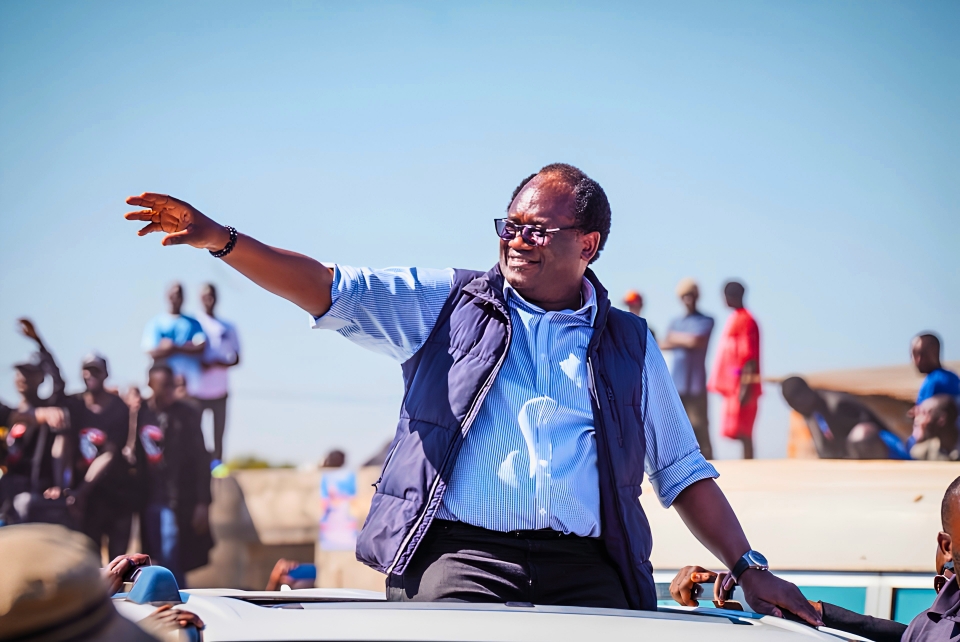
By Brian Matambo | Sandton, 14 July 2026
I have travelled with incoming Republican President, President Brian Mundubile, on the campaign trail through Eastern, Muchinga, Northern and Luapula provinces. I have listened to him in provincial capitals, rural districts, farming communities and mining areas. What has become clear is that his campaign is not being built around abstract political slogans. It is being built around the pain that ordinary citizens carry home every evening.
That is why President Mundubile will edge President Hakainde Hichilema on August 13. The election will not be decided by economic terminology and graphs, debt-restructuring speeches or impressive statistics alone. It will be decided by the teacher drowning in debt, the farmer receiving inadequate inputs, the parent struggling to buy uniforms, the youth chased from a small-scale gold or sugilite mine, and the family travelling on a road that the government has neglected for years.
President Mundubile has promised to continue the Social Cash Transfer programme, but to remove discrimination from its administration. This is an important distinction. He is not threatening vulnerable citizens with the cancellation of support. He is promising that elderly people, persons with disabilities and poor households will receive assistance because they qualify, not because they belong to the ruling party, are a certain tribe, or know someone in authority.
He promises to restore the debt-swap policy, which may become one of the most powerful issues in this election. Civil servants are employed, but many are not financially free. Loan deductions have reduced teachers, nurses, police officers and other public workers to spectators on payday. President Mundubile is offering them relief that can be measured directly on their payslips.
On education, President Mundubile is not proposing the abolition of free education. He is exposing the difference between free education and quality education. A child does not receive a proper education simply because no tuition fee is charged. He argues that access to education is not enough when classrooms are overcrowded, teachers are overwhelmed, books are unavailable, and parents must still struggle to purchase uniforms and essential learning materials.
Under his proposed administration, free education would become free quality education. He has promised to work towards a teacher-to-pupil ratio in which one teacher handles approximately 30 to 40 learners, instead of situations where a single teacher may be expected to manage more than 100 pupils.
A child may be physically present in a classroom and still receive very little education. When classrooms become warehouses for children rather than environments for learning, free education exists more convincingly in government speeches than in the lives of pupils.
President Mundubile has further promised that free education will include books and school uniforms.
His proposal that women in surrounding communities should receive contracts to sew uniforms introduces an important economic dimension. The policy would not only assist schoolchildren. It would also create local business opportunities, support women’s cooperatives and allow education expenditure to circulate within communities.
That is how a social programme becomes an economic programme. The child receives a uniform, the school receives support, and the woman in the community receives business. That is what policy should do: solve more than one problem at the same time.
In mining communities, President Mundubile is promising to return legitimate small-scale mining opportunities to Zambian youths who have been displaced from their mining areas. He is also proposing local Ministry of Mines offices to provide safety training, environmental guidance, business support and licensing. A young miner in Mpika, Nyimba, Mufumbwe or Chingola should not have to travel to Lusaka to legalise an activity taking place in his own district.
For farmers, the promise is equally direct: eight bags of fertiliser for each qualifying beneficiary under the Farmer Input Support Programme. Farmers understand the difference between receiving enough inputs to cultivate and receiving inputs in medas. They cannot plant speeches, statistics or promises. They need seed, fertiliser, markets and timely payment.
President Mundubile’s promise of a “Second Independence” is also gaining political meaning. He is pledging to repeal cyber laws and other legal provisions that have been used to weaken freedom of expression. Zambia cannot call itself free while citizens fear that a social-media post, political opinion or criticism of government may result in arrest. The first independence removed colonial rule. The second, he argues, must restore the citizen’s voice and bring economic freedom through stable and predictable constitutionalism.
His promises on roads are equally rooted in reality. The Lundazi-Chasefu-Chama road towards Shiwang’andu and the Mansa-Chienge road are not decorative projects. These roads connect farmers to markets, patients to hospitals, traders to customers and districts to the national economy. A bad road is not merely an inconvenience. It is a tax on every bag of mealie meal, every litre of fuel and every agricultural product transported through that area.
President Mundubile has also promised to address the housing deficit among civil servants and create a realistic path towards home ownership. Many public workers serve the country for decades and retire without a house. A serious housing programme would not only give them dignity and security; it would also create jobs in construction, support local manufacturers and stimulate the wider economy.
Hichilema will ask voters to judge him on economic stabilisation and debt restructuring. President Mundubile is asking them to judge the government by the condition of their households. That is the danger facing the incumbent. The national balance sheet may be improving, but millions of personal balance sheets are still collapsing.
Crowds alone will not win the election, and promises must eventually be backed by credible implementation. But President Mundubile has identified the groups that may decide on August 13: indebted civil servants, neglected farmers, unemployed youths, struggling parents, small-scale miners and citizens worried about their freedoms. He is speaking to the realities they live with every day. That is why he may not merely challenge Hakainde Hichilema. That is why he may edge him.
Leave a Reply